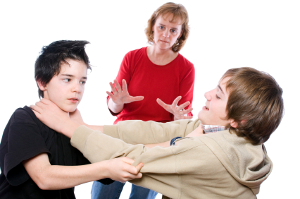
Why are our kids often at each other's throats in the summer? The
biggest cause of fighting during the long summer break is the fact that you're
spending a whole lot of time together. If external stresses increase--if there's
trouble at work, a bad break-up for one of your teens, or you're caring for a
sickly relative, for example--so does the tension inside your house. We all start
to feel boxed in when this happens, and it's easy to lose your temper at moments
like these. Your kids begin to act out, too, the typical pattern of name-calling,
teasing, criticizing and bossing each other around increases until the
atmosphere is thick with everyone's annoyance and bad feelings.
Here are some tips to calm the environment if
you find you're consistently getting on each other's nerves during the summer.
1. Stop, breathe, and do not react. Don't respond until you've given yourself
that moment of pause to think about what you want to say. You don't have to
respond to your kids just because they're yelling at you. You always have a
choice how you respond to your children's behavior. You don't have to go to
their level and scream or slam doors. As James Lehman says, "You don't have to
attend every fight you're invited to." Believe me, I know it's hard when your
kids get in your face. The natural reaction would be to just do it back, whether
it's name-calling, saying hurtful things, or issuing ineffective ultimatums,
like "You're grounded for the summer." So take those few seconds to pause and
think. Take a time out if you need one--and above all, don't sink to your
child's
level of immature communication if at all possible.
2. Respond with a question rather than a snap judgment. So instead of screaming
back at your child, after you stop, breathe and pause, say to yourself, "What's
going on here? What's a better way for me to respond?" To your child, you can
say, "Let's come back to this discussion once everybody calms down. We're not
going there right now because nothing good is going to come out of the
conversation when everyone's upset. When you can come back, we can talk about
this in a calm way and work things out."
3. Make a conscious decision to change. You, the parent, have to make a
conscious decision that this summer is not going to be a constant fight with
your child. And if you don't want it to be about arguing and fighting, then you
have a role to play in making that happen. That means you're not trying to
control your child and tell him how to be--rather, you're deciding how you're
going to be. Take a position of responsibility around how you're going to act.
If you're reactive and just go with the knee jerk, that's not taking charge of
yourself.
You'll have a much better response if you can stop and think, "How can I best
respond to this? How will I get a better result?" That doesn't mean you will--it
just means that you are going to be that person you want to be if you looked in
the mirror--no matter how your kids are behaving.
When I give this advice to my clients, sometimes they say to me, "How can I do
that, Debbie? It's impossible; I can't." But time and time again, I've seen
parents surprised at what a difference it makes when you commit to being that
calm person in response to the upset.
4. Get on the roof and get perspective. Recognize how you react when you feel
closed in, then try doing things a new way. As I say, "Instead of hitting the
roof, head for the roof." What that means is that when things get too crazy,
imagine taking yourself out of the fray by going up onto your roof. Look down at
your kids and your family--and all your reactions to each other. Try to really
see more objectively what's going on. What are the patterns in your family that
might be contributing to the fighting? Once you understand your own part of the
dance, you are that much closer to a peaceful home life. And when you can change
your part of that pattern, others in your family might step up and follow your
lead.
So for example, you'll see teenagers in particular constantly provoking fights
with their parents. These adolescents are often feeding into it, because they're
connected to their parents this way. Your job is to not react and feed that part
of your child. Give him or her appropriate attention, but don't indulge
screaming matches because then they're just going to keep coming back for more.
Sibling Fighting
If you find your kids are on top of each other all summer, it's possible they
don't have enough time away from each other and need more structure in their
days. When they're bored and there's nothing to do, understand that it's also an
activity to pick on their brother or sister--and to get some reaction from you.
Part of it is that your kids want a reaction from you because, again, it keeps
them connected to you--even if it's negative attention.
You can't stop your kids from arguing, but you can influence them to argue less.
Make it one of your goals to structure things more. Try to make sure they have
some away time from each other. Work to manage time a little better so your kids
are not on top of each other all the time--that in itself will help. Older teens
might get a part-time job, and younger kids might sign up for a day camp, for
example.
If what they're doing is just typical sibling bickering, the rule of thumb is to
more or less stay out of it. You can say things like, ?You guys need to solve
this problem if you want to watch the TV at all.? So in this way, your kids are
motivated to solve their own problems because they're not going to have access
to something if they don't. You can also say, "You guys can keep fighting, but
you need to do it out of this room because I don't want to hear all the noise."
You're not giving them negative attention and you're not getting into their
triangle. And that's essentially what they want you to do--be pulled in and side
with one of them. And that, ultimately, will cause real sibling hostility if it
continues to happen, because one child will feel like, "Mom always favored my
brother over me." Don't take sides, because when you do, you create an
odd-man-out situation.
Remember, this is a good time to help your kids figure out how to work things
out together, because they're going to have the consequences if they don't deal
with whatever they're fighting over.
Is It Possible to Have a Peaceful Summer?
It's absolutely possible to have a peaceful summer, and you do that by taking
control of how you want things to go. You have control--even if the only thing
you have control over is yourself. It's not dependent on how your kids are--it's
how you decide to be. And mark my words: if you're trying to control your kids,
you're going to have a lousy summer.
One other suggestion is to make a list of what you will commit yourself to do
and not to do to make sure the summer break is peaceful. Write down your own
bottom lines and the structures you're going to create. Remember, you have a
choice as to how you act and interact with others, and this can make the
difference whether the interaction goes north or south.
(Kids Fighting? Read This Before Summer Starts reprinted with permission from Empowering Parents)
by Debbie Pincus, MS LMHC, Member of The Total
Transformation Advisory Board
For more than 25 years, Debbie Pincus MS LMHC has
offered compassionate and effective therapy and coaching, helping individuals,
couples and parents to heal themselves and their relationships. Debbie also
facilitates parenting groups and is the author of numerous books for young
people on interpersonal relations.